
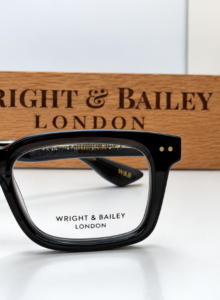
Distinctive Wright & Bailey London eyewear arrives at Rawlings
We’re delighted to welcome Wright & Bailey London to Rawlings – a distinctive eyewear collection combining contemporary design with a strong sense of heritage style. Choosing new glasses isn’t simply about finding something that helps you see clearly. Eyewear is an important part of your personal style, and the right frame can subtly change your whole look.
That’s one of the reasons Wright & Bailey London caught our eye.
Contemporary eyewear with a heritage feel
There’s something immediately familiar about the Wright & Bailey London collection. Inspired by the elegance and glamour of the mid-20th century, classic eyewear shapes are given a fresh, contemporary interpretation. Think heritage styling with a modern edge – beautifully proportioned shapes, bold acetates, refined metals and colours ranging from understated classics to more individual statement frames. The result is eyewear that feels timeless rather than traditional. There’s plenty of personality, but the frames remain elegant and very wearable.
Inspired by another era
Wright & Bailey London doesn’t just take inspiration from the style of the past – the collection comes with its own rather charming heritage narrative. The story takes us back to 1950 and a chance meeting in the London Library between Dr Wright, an ophthalmologist with an appreciation for precision and beauty, and Mr Bailey, a master craftsman with a passion for fine workmanship. The two discovered a shared vision for creating eyewear that would be more than simply functional. Together they began developing frames that combined optical expertise with craftsmanship, elegance and enduring style. Sketches and prototypes followed, before being tucked away for decades and eventually rediscovered and brought to life for a new generation.
Whether it’s the legend of the 1950s setting, the evocative frame names or the distinctly vintage aesthetic, it all adds to the character of Wright & Bailey London – nostalgic in inspiration, but designed to be worn today.
Eyewear with personality
Wright & Bailey London describes its approach as “conservatively different”, and we think that sums up the collection rather nicely. These are frames for people who appreciate classic styling but want something a little more individual. Some designs make their presence known; others are much more understated. What brings them together is that unmistakable heritage influence combined with contemporary styling. And sometimes the frame you fall in love with isn’t necessarily the one you expected to choose.
That’s where having an experienced dispensing team can make a real difference. At Rawlings, we’ll help you explore different shapes, colours and styles while considering your prescription, facial features, fit and how you’ll use your glasses from day to day.
Because the best frame isn’t simply the one that catches your eye. It’s the one that feels completely right when you put it on.
Finding your next pair
We think choosing new glasses should be enjoyable. It’s an opportunity to try something different, experiment with your look and perhaps discover a style you wouldn’t previously have considered. Of course, looking good is only part of choosing new eyewear. Our experienced dispensing teams will consider how a frame fits, how it works with your prescription and which lens options will best suit your vision and lifestyle – bringing everything together to create a pair of glasses that looks and feels right for you.
The arrival of Wright & Bailey London gives us another distinctive collection to offer alongside the carefully selected eyewear already available across Rawlings.
So, if you’re ready for a change – or simply curious to discover what suits you – come in and explore the collection.
Visit your local Rawlings practice and discover Wright & Bailey London for yourself.

Do you have Astigmatism or are a Varifocal or Reading Glasses Wearer? Contact Lenses Could Still Be an Option
Think your prescription means you can’t wear contact lenses? You might be surprised.
Contact lens technology has come a long way, and today there are options for many people who may once have been told that contact lenses weren’t suitable for them. That includes people with astigmatism, as well as those who normally wear reading glasses or varifocals.
Can I wear contact lenses if I have astigmatism?
In many cases, yes.
Astigmatism is very common. It occurs when the front surface of the eye – or sometimes the lens inside the eye – has a different curvature in one direction than another. This affects the way light is focused and can cause blurred or distorted vision.
Contact lenses designed to correct astigmatism are known as toric lenses. Unlike a standard spherical contact lens, a toric lens needs to sit in the correct position on the eye to provide clear, stable vision.
Modern lens designs use clever technology to help keep the lens correctly orientated as you blink and move your eyes. Depending on your prescription and individual needs, both daily disposable and reusable toric contact lenses may be available.
What if I wear varifocals or reading glasses?
Needing help with reading doesn’t necessarily mean giving up on contact lenses either.
As we get older, the natural lens inside the eye gradually becomes less flexible, making it more difficult to focus on close objects. This is called presbyopia and is the reason most of us eventually need some help with near vision.
Multifocal contact lenses are designed to provide vision at different distances through the same contact lens. For suitable wearers, they can reduce reliance on reading glasses or varifocal spectacles and offer greater freedom for everyday life, work, exercise, holidays and social occasions.
They won’t necessarily give exactly the same visual experience as your varifocal spectacles, which is why careful fitting and realistic expectations are important. Your optometrist can talk you through the different options and help find the best balance for your individual needs.
What if I have astigmatism AND wear varifocals?
You still shouldn’t assume contact lenses are out of the question.
There are multifocal toric contact lenses designed to correct both astigmatism and presbyopia. Suitability will depend on your prescription, eyes and visual requirements, but developments in contact lens design mean there are more possibilities than many people realise.
Tried contact lenses before and didn’t get on with them?
It may be worth trying again.
If you experimented with contact lenses several years ago, or were previously told that your prescription was unsuitable, things may have changed. Lens materials, prescription ranges and designs continue to develop, and there may now be options that weren’t available when you last tried.
At Rawlings, a contact lens assessment considers your prescription, eye health, lifestyle and what you want your contact lenses to do for you. We’ll recommend appropriate options, teach you how to handle and care for your lenses safely, and give you time to get used to them.
So whether you have astigmatism, wear reading glasses or varifocals, or have simply assumed your prescription is too complicated for contact lenses, it’s worth asking the question.
Talk to your Rawlings optometrist or contact lens team and find out whether the latest contact lenses could work for you.
 Have you ever been sitting in a busy restaurant and realised you’re struggling to follow the conversation?
Perhaps you can hear that somebody is talking, but individual words become difficult to pick out. Or you find yourself concentrating intensely on one person while conversations and background noise seem to merge together.
These experiences can be surprisingly tiring – and they can sometimes be an early indication that your hearing has changed.
Hearing isn’t simply about volume.
Your auditory system is constantly working to separate the sounds you want to hear from everything happening around you. In a quiet room with one person speaking, this task can be relatively straightforward.
Move that same conversation into a busy restaurant, family gathering or social event and things become considerably more complicated.
Music, clattering plates, several conversations and people speaking from different directions all compete for your attention.
When hearing begins to change, separating speech from background noise can become more challenging.
You may notice yourself asking people to repeat themselves more frequently, turning towards someone to hear them better, missing parts of conversations or relying more heavily on watching people’s faces.
Sometimes it’s other people who notice first.
Friends or family might comment that the television seems louder, or that you’ve misunderstood something they’ve said.
Because hearing changes are often gradual, it can be easy to adapt without really noticing you’re doing it.
A hearing assessment isn’t simply about whether you can hear a series of beeps.
At Rawlings, we want to understand how you’re hearing in real life and which situations you’re finding difficult.
If a hearing change is identified, our audiology team can explain the results clearly and discuss what might help. That doesn’t automatically mean hearing aids – the first step is simply understanding what’s happening.
With Christmas and the festive season approaching, there will soon be plenty of dinners, parties and family gatherings filling our calendars.
If you’ve noticed that those occasions aren’t quite as easy to follow as they once were, this could be a good time to have your hearing checked.
Book a hearing assessment with Rawlings and get a clearer picture of your hearing health.


Back at School – But Are They Seeing Clearly?
The new school year is now well underway. New teachers have been met, routines established and the summer holidays probably feel like a distant memory.
But now that children have settled back into the classroom, it’s a good time to ask an important question:
How well are they seeing?
Children rely heavily on their vision for learning. Reading and writing, using tablets and computers, copying information displayed at the front of the classroom, sport and many other everyday school activities all place demands on their eyes.
And if a child is struggling at school, finding reading difficult or losing concentration, their vision is one of the first things worth checking.
Children don’t always know they can’t see clearly
A child may have no idea that their vision is different from anyone else’s. If their sight has changed gradually, they may simply assume that what they see is normal.
Instead of saying, “I can’t see properly”, there may be more subtle clues. You might notice that they:
A teacher may notice that they struggle to see information displayed at the front of the classroom or need to move closer to see clearly.
But importantly, some children with a vision problem show no obvious signs at all.
What about myopia?
One condition we are particularly aware of during childhood is myopia (short-sightedness).
A child with myopia can usually see things clearly when they are close, while objects further away become blurred. Myopia commonly develops during childhood and can progress as the eyes continue to grow.
Regular eye examinations allow your optometrist to detect myopia and monitor changes in your child’s prescription. If myopia is progressing, we can also discuss whether myopia management may be appropriate.
Don’t wait for your child to tell you something is wrong
An eye examination isn’t simply about finding out whether your child needs glasses. Your optometrist will assess their vision and how their eyes are working together, as well as examining the health of their eyes.
NHS sight tests are free for children under 16, and for young people under 19 who are in full-time education. Children will normally be advised when their next routine eye examination is due.
However, if you, your child or their teacher has noticed a new problem with their vision, don’t simply wait until their next routine appointment. Contact your Rawlings practice and tell us what you’ve noticed so that we can advise you appropriately.
And if your child is struggling at school? Checking their vision is a very good place to start.
 Summer is over, temperatures are dropping and the evenings are getting darker.
Time to put the sunglasses away until next year?
Not quite.
We naturally associate sunglasses with hot summer days, holidays and sitting outside in the sunshine. But protecting your eyes from the sun isn’t something that only matters between June and August.
Ultraviolet radiation from the sun is present throughout the year, including on cooler and cloudy days.
That’s why a good pair of sunglasses is about much more than simply reducing brightness. Quality sunglasses should provide appropriate protection against UVA and UVB radiation.
So while you may not reach for your sunglasses as frequently in October as you would in July, there will still be plenty of days when they’re worth having with you.
Autumn also brings another very practical reason to keep your sunglasses close at hand.
As the sun sits lower in the sky, it can create significant glare – particularly when you’re driving.
Anyone who has turned a corner on an autumn morning and suddenly found themselves looking directly towards a low sun will know just how uncomfortable and distracting it can be.
Sunglasses can help reduce that brightness and make conditions more comfortable.
Polarised lenses can be particularly useful for reducing reflected glare from surfaces such as wet roads, water and car bonnets.
Needing prescription lenses doesn’t mean you have to choose between seeing clearly and wearing sunglasses.
Prescription sunglasses can be made for many different prescriptions and lens types, giving you clear vision alongside sun protection.
There are also photochromic lens options that react to changing light conditions, although their performance and suitability will depend on where and how you intend to use them.
Our dispensing team can talk you through the differences and recommend options based on your prescription and lifestyle.
So before your sunglasses disappear into a drawer until next summer, you might want to reconsider.
From protecting your eyes against UV to helping with that troublesome low autumn sun, sunglasses can earn their place in your bag, pocket or car throughout the year.
Visit your local Rawlings practice to discover our latest sunglasses and prescription sunwear.

We were thrilled to present a cheque to our latest feedback winner. Emma Davies dropped into her local branch at Winchester this month to collect her prize. Congratulations Emma!
For your chance to win, don’t forget to leave feedback for one of our branches or find out more here.
